
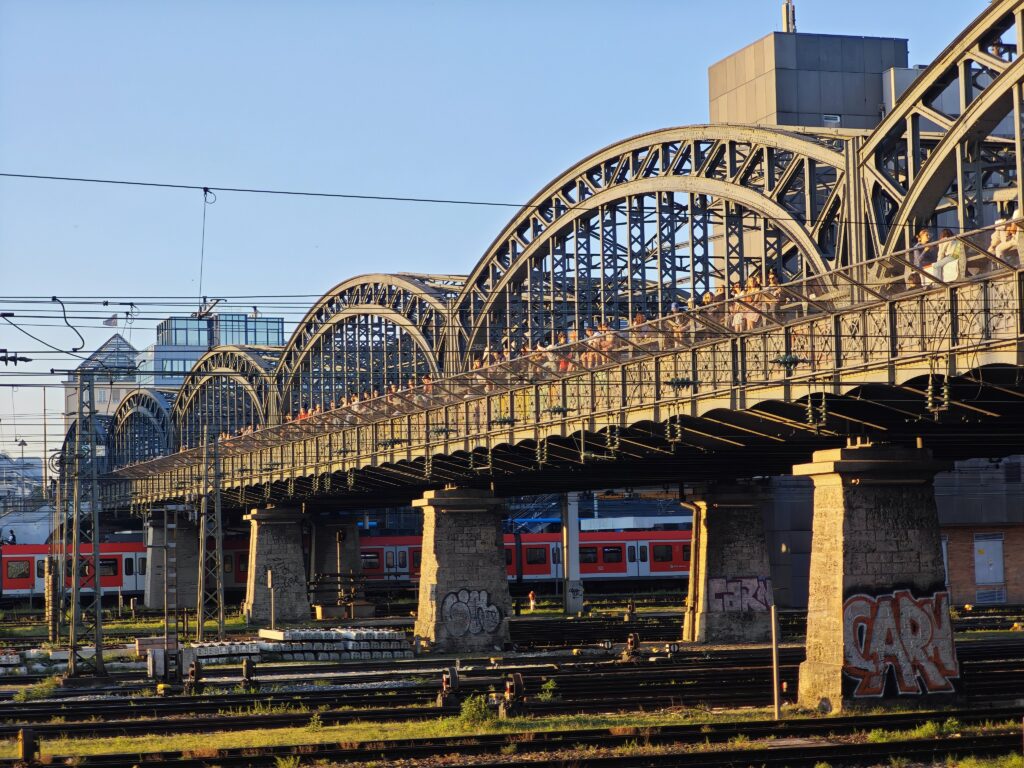
The Hackerbrücke History: A journey through Munich’s transport history
If you stroll across the Hackerbrücke today, you’re standing on a true testament to Munich’s industrialization . At the end of the 19th century, the city was bursting at the seams, and the railway boom necessitated a massive expansion of the rail network. Where a small, rather inconspicuous bridge stood around 1870, something larger was suddenly needed to span the ever-expanding track area leading up to the main train station. Thus, between 1890 and 1894, the structure we know today was built. Incidentally, it owes its name to one of its largest neighbors at the time: the Hacker Brewery . The brewers of Hacker-Pschorr had their premises there, and so the bridge quickly became known colloquially as the “Hackerbrücke,” a name that was later officially adopted.
A technical masterpiece made of millions of rivets
What makes the Hacker Bridge so technically special only becomes apparent upon closer inspection. Nothing here was welded, as would be done today. The entire structure is made of riveted wrought iron – a true product of the Gründerzeit (the period of rapid industrial expansion in Germany in the late 19th century), built by the Maschinenbau-Actien-Gesellschaft Nürnberg, which we know today as MAN. Engineers refer to it as a tied-arch bridge or a “Langer beam.” That sounds complicated, but it simply means that the six large arches distribute the load extremely cleverly via tie rods. At the time, this was cutting-edge technology and the only way to span the 26 tracks without countless piers between the rails. This delicate network of steel and rivets is now one of the last great industrial monuments of its kind in Germany.
Between war scars and the Olympic boom
The bridge’s history, however, was not without its dramatic upheavals. During the Second World War, the northern section in particular was heavily damaged by bombs. It is truly fortunate for Munich’s cityscape that, after the war, the decision was made against a modern new construction and in favor of a faithful reconstruction . It was rebuilt according to the original plans in 1953. The bridge then experienced a second springtime during the 1972 Olympic Games. With the opening of the S-Bahn main line and its own station, it finally became a vital artery for the city. Since then, especially during Oktoberfest, it has been the first point of contact with Munich for millions of people who disembark from the S-Bahn there and stream towards the Theresienwiese .
From transport hub to the city’s living room
It’s fascinating to see how the bridge’s significance has changed over the decades. What was once a purely functional structure for carriages and early automobiles is now a tourist attraction. Every summer evening, the cold steel becomes the “living room” of Munich’s youth. People sit on the girders, enjoy the sunset over the tracks, and let the day wind down. The last major renovation in the 1980s thankfully preserved this charm. But the next big test is already on the horizon: a comprehensive renovation is planned for 2027. This isn’t just about rust protection, but also about the exciting question of whether the bridge might become completely car-free in the future, thus offering even more space for people and their sunset moments. –> all about the Hackerbrücke Renovation
Related Links:
- all the info to the hacker bridge
- the Hackerbrücke is worth?
- close to ZOB München