
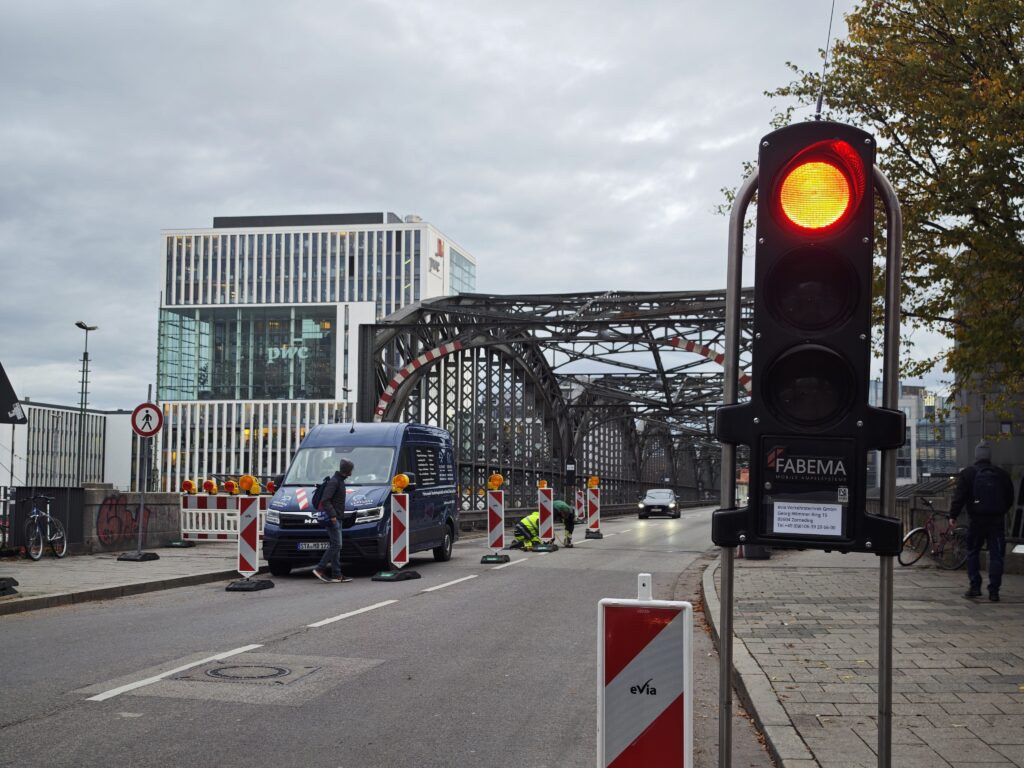
Hackerbrücke renovation: What you should know
The historic Hackerbrücke bridge will undergo a complete overhaul starting in 2027. The city council approved the renovation in December 2025 and has allocated €50 million for the project. The restoration of the monument will take three years.
The Hackerbrücke, a listed historical monument in Munich, is about to undergo a comprehensive renovation. This important construction project is part of the City of Munich’s “Coordinated Bridge Preservation Program” and aims to ensure the bridge’s long-term structural integrity and safety. All work is being carried out in close consultation with the Lower Monument Protection Authority and the Bavarian State Office for Monument Preservation.
During routine structural inspections, significant damage , particularly corrosion , was discovered on the two main supporting structures of the Hacker Bridge . The Munich City Construction Department considers a complete overhaul to be the “only technically and economically viable solution” to ensure the bridge’s stability and long-term durability. The bridge will be completely closed to private motorized traffic for the entire duration of the renovation.
Schedule and duration of the Hackerbrücke renovation
The complete renovation of the Hacker Bridge is planned for the period from the beginning of 2027 until approximately the end of 2029. The work will therefore take around three years . The restoration will be carried out in two phases . Only one half of the bridge will be renovated at a time, while the other remains open. The renovation includes a variety of measures to preserve the historical structure and ensure the bridge’s functionality for the future.
- Corrosion damage repair: Rust is removed and damaged steel parts are replaced.
- Inspection and modernization of the foundations: The base of the bridge will be repaired to ensure its stability.
- Historic preservation: All measures are carried out in close coordination with the Lower Historic Preservation Authority and the State Office for Historic Preservation in order to preserve the character of the delicate riveted timber frame construction.
- Lighting improvements: New special lighting effects are planned to highlight the bridge as a landmark, even in the evenings.
- Optimization for cycling and pedestrian traffic: The side areas may be widened, cycle lanes added and bicycle parking spaces provided.
- Technical adjustments: The feasibility of an underground utility culvert is being investigated to remove pipes from the bridge structure.
- Coordination with Deutsche Bahn: The renovation work must be synchronized with the planned measures of Deutsche Bahn (DB InfraGO) for the reconstruction and expansion of the Hackerbrücke transport stop.
Impact on traffic
The renovation will have a significant impact on traffic in Munich:
- Car traffic: The Hackerbrücke bridge will be closed to car traffic for the entire construction period . This is expected to lead to major traffic jams during rush hour in Munich’s city center, as the Hackerbrücke is an important hub for many commuters.
- Pedestrians and cyclists: The use of the Hackerbrücke bridge by pedestrians and cyclists should remain largely unrestricted .
- Oktoberfest: Especially during the Oktoberfest period (September to early October), the bridge will be fully accessible to ensure access to the festival grounds.
- S-Bahn and ZOB: Access to the Hackerbrücke S-Bahn station and the central bus station (ZOB) as well as access for emergency services should be guaranteed during the construction period .
Costs of the Hackerbrücke renovation
Regarding the costs for the renovation of the Hackerbrücke bridge, there has been absolute clarity since the end of 2025. The City of Munich has officially approved the project and set the budget. In December 2025, the Munich City Council’s Construction Committee granted official project approval for the comprehensive refurbishment. With a projected budget of approximately 50 million euros (gross), this is one of the city’s most ambitious renovation projects.
The costs include not only the extensive restoration of the historic steel and concrete structure but also complex preparatory measures. For example, all power and telecommunications cables must be rerouted to temporary lines before the actual work can begin. The costs also include new lighting effects that will illuminate the bridge at night.
Long-term perspective: Hackerbrücke car-free?
After the renovation is complete, the Hackerbrücke bridge will be more attractive for pedestrians and cyclists. The City of Munich’s Mobility Department will monitor traffic on and around the bridge during the construction period and subsequently submit a recommendation to the City Council regarding future traffic flow on the bridge. It is therefore conceivable that changes to private motorized traffic will occur after the renovation. In plain terms, this could mean: no more cars on the Hackerbrücke. –> Hackerbrücke car-free
Related Links:
- all about the Hackerbrücke
- best Hackerbrücke parking by car
- close to ZOB München